Konark Festival showcases India’s dance and heritage
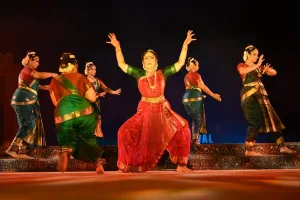
The 36th Konark Festival of dance held recently, conducted by Odisha Tourism in association with Odisha Tourism Development Corporation, highlighted its history of art, architecture, and dance.
Tapati Chowdhurie | Kolkata | January 10, 2026 8:53 am
Photo:SNS
The 36th Konark Festival of dance held recently, conducted by Odisha Tourism in association with Odisha Tourism Development Corporation, highlighted its history of art, architecture, and dance.
Here is an excerpt from the five day long festival held in an open air three tier performance space created with the Majestic Konark temple as its backdrop. A sight worth a million dollars.
Advertisement
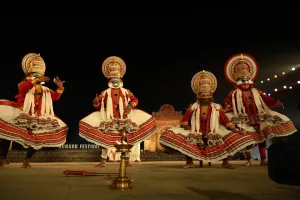
Duryadhana Vadam in Kathakali dance theatre style was a spectacular performance by Kerala Kalamandalam, founded in the year 1930 by the visionary poet Vallathol Narayana Menon.
Advertisement
It was heartening to see Vayaskara Aryan Narayanan Moosad’s attakatha on the killing of Dussasana named Duryodhana Vadham, which dramatised pivotal moments from the Mahabharata, tracing Duryodhana’s arrogance and the downfall of the Kaurava Dynasty. The play unfolded the deceitful Duryodhana and his crafty uncle Shakuni defeating the Pandava brothers in a game of dice, which caused the great battle of Kurukshetra. The drama embodied the conflict between adharma and dharma, in which dharma inevitably wins. The drama displayed the game of dice, Draupadi’s dishonour, Krishna’s divine intervention, and the fierce fulfillment of Bhima’s vow within the given time, through symbolic gestures, heightened expressions, and stylised battle sequences, culminating in the horrendous killing of Dussasana by Raudra Bhima, restoring cosmic order. It was a spectacular show.
Aficionados of Bharatanatyam were treated to Shankarananda Kalakshetra Ensemble’s remarkable presentations Dashavataram- a Keertanam written by Bhakta Ramdas describing the avatars of Maha Vishnu.
In the Pallavi and charanam of the keertana, the poet speaks of the protection Vishnu bestows to mankind by descending on earth as Avataras.
Vishnu has incarnated in the past as a fish to destroy the deceitful Somaka; as a turtle to bear the Mandara Mountain on his back to help the Devatas; as a boar to destroy Hiranyaksha; as Vamanavataram to humble proud Mahabali; as Parasuramavataram to punish Kshatriya kings; as Ramavataram to destroy the ten-headed Ravana; as Balaramavataram of the Yadu dynasty, he gave us strength; as Krishnavataram to kill evil Kamsa, and he will appear as Kalki to save us from Kali Yuga, reiterating Rama as our protector.
Devi Upasakam was about the worship of Mother Goddess who helps mortals to alleviate darkness and falsehood and rise towards light and truth. The Vaggeyakara Muthaiah Bhagavathar, in this Daruvu Varnam, consisting of swaram, sahithyam, and Jathi syllables, worships Devi Meenakshi as the quintessential warrior princess, who falls in love with Shiva and his different forms. Devi, who is the embodiment of the primordial Omkaara, that ultimately leads to Moksha, was the penultimate piece. Devi, coupled with Shivoham have placed Meenakshi and Shiva at the core of the Bhaktas’ hearts who request to be blessed.
Shambo Shiva is the Sabhapathy who danced at Chidambara. The choreographer has mentioned his myriad names, thereby giving him a different dimension altogether, and has beckoned all his devotees to Kailasha to watch the cosmic dancer Nataraja, the creator of the life and breath of the universe.
In a nutshell, Ananda Shankar upheld India’s philosophy in a quick run-over of our ancient literature through Kalakshetra Bani, which has provided her with the roots to enthuse the lover of our ancient philosophical thoughts. Bhakti was the uppermost thought guiding her in her journey.
Bimbati Devi’s presentation of Leelakamal reminded us about Shrikrishna’s proclamation in the Bhagavat Gita, that whenever the world is overtaken by evil, he will take birth to redeem mankind.
Leelakamal was inspired by the traditional dances of Goshthaleela, composed originally by the legendary Guru Bipin Singh, rechoreographed by Bimbavati Devi.
Goshthaleela is traditionally performed in the temple premises on Gopasthami in the month of Kartik, in which Krishna and the sakhas go to the meadows to tame the cattle. Different leelas of Krishna follow, and eventually good triumphs over evil.
Leelakamal is a blend of ritualistic dance and music that is an essential part of the various Vaishnava performing traditions of Manipur. It is inspired by the traditional Goshthaleela (Sansenba in Meitei) of Manipur. Bimbadevi’s rechoreographing of some of Guru Bipin Singh’s compositions using traditional songs and bols of Natasankirtana was accomplished with great sensitivity. Bakasur Vadh was redecorated differently, keeping in mind a senior set of dancers to enact Bakasur Moksha. It was elevated to not just the killing of the demon bird. Excerpts from the ritualistic songs of Natasankirtana made it all the more beautiful. Other verses from different Vaishnava texts were also used like Achintyashakti Sampanna sa Krishna Karunamaya.
Through the celebrations held in the month of Karthik, Krishna is seen as a symbol of protection and goodness. It is a lesson in making the world a place where the only truth is goodness.
The music ensemble enhanced the beauty of the story.
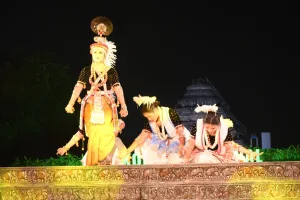
Odissi exponent Sharmila Biswas made her mark right from the start with Mangalacharan performed in a group, featuring the sublime Mahalakshmi Stotram from Padma Purana, bringing to life the imagery of the Goddess, inspired by Patachitra Paintings, classical sculptures, and traditional shadow puppets showing their dramatically swaying silhouettes, transforming the performance into more than just a visual treat. It offered a profound homage to the deep traditions they represent.
Mahalakshmi, the embodiment of grace and strength, symbolising prosperity and stability, was celebrated.
Composer Srijan Chatterjee and choreographer Sharmila Biswas created a spell.
Through a series of simple activities and engaging games, Abartan Bibartan seamlessly transformed into a display of complex rhythmic patterns showcasing the entire spectrum of traditional Odissi Taalas. By breaking conventional boundaries, Sharmila attempted to transcend the grammar of the form in favour of the storytelling potential of the Odissi Taalas.
Sharmila applied relatively unknown percussion instruments of Odisha to enrich the rhythmic soundscape.
It was a dynamic presentation where play met precision, and tradition was explored anew.
Shrishti-Tatva or Dashavatar concluded her recital, where ancient wisdom met modern science. The ten avatars of Vishnu -an ancient evolutionary sequence articulated in the Puranas and the work of Jayadeva was structured according to Srishtitatva (the knowledge of creation).
Incarnations of Vishnu and their significance were connected with Darwin’s theory of evolution and presented in a manner never seen before. It was danced with power and grit. The dance, the music, the chants evoked spiritualism both to the lay audience and the connoisseurs. It was a masterpiece. Mythology and philosophy were woven in seamlessly.
Guru Ratikant Mohapatra’s ensemble presented Adviteeyam with star musicians and modern light designer Devi Prasad Mishra.
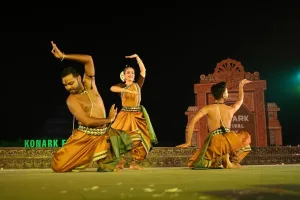
Shankaracharya’s Ardhanarishwara Stotram, which celebrates the divine unity of Shiva and Parvati, portraying them as two inseparable halves of one eternal consciousness, was performed in a choreography-by Ratikanta to a composition of Raghunath Panigrahi. Shiva and Parvati dancing in one body with the help of two or more dancers was marvelous. The story marched forward, in immaculate Odissi style, both inherited and enhanced by the choreographer-par-excellence.
Yugmadwanda Pallavi unfolded an intricate interplay of movement and music, where lyrical choreography met rich rhythmic complexity. Innovations in design and tempo of Yugmadwanda Pallavi offered a vibrant interpretation within the classical structure with the addition of a dialogue between dancer, vocalist, percussion, and melodic instruments, which created an entertaining sawaal-jawaab.
Nachanti Range Shri Hari, displaying flautist Krishna dancing in divine ecstasy, with the Gopis who are enchanted, was heart winning.
Obeisance to Surya Deva through the display of Karanas, physical balance, coordination, strength and agility, and formations like that of the gotipuas was entertaining.
The journey will begin from Delhi Safdarjung and would cover Varanasi, Kolkata, Gangasagar, Puri, Bhubaneswar, Konark, Chilika and Baidyanath Dham before returning back to Delhi.
The event has emerged as a platform to highlight Odisha’s rich heritage, vibrant traditions, exquisite handicrafts, handlooms, authentic cuisine and diverse tourism experiences, while strengthening cultural and people-to-people ties between Odisha and Assam.